

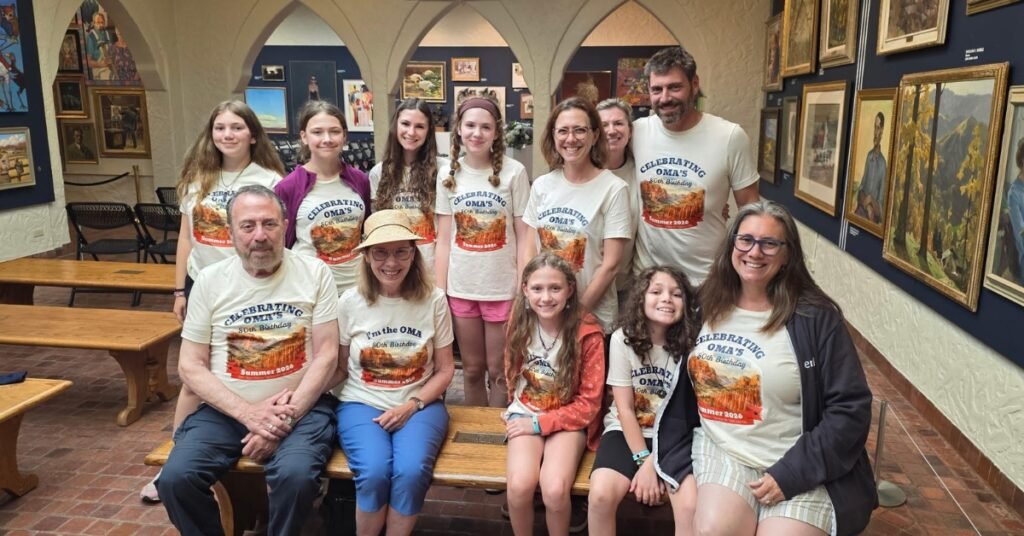
Most people celebrate their 80th birthday with a party. I’m celebrating mine by taking my children and grandchildren on a pilgrimage to Springville, where I will stand at my mother’s grave in Evergreen Cemetery and recite Kaddish, the traditional Jewish prayer for the dead.
Springville produced a woman who remained deeply connected to her hometown after converting to Judaism, marrying a Holocaust refugee, raising Jewish children in Indiana, and ultimately choosing to come home beneath Utah’s mountains. That woman is my mother.
My mother was born and reared in Springville, the daughter of Dr. George Anderson and Nelly Jacob Anderson. George Anderson was a beloved family physician who later became mayor of the city. Mother graduated from Brigham Young University, earned a master’s degree at New York University, and eventually settled in Terre Haute, Indiana, where she met my father, a Jewish physician who had escaped Nazi Germany.
Before their marriage, she converted from the Church of Jesus Christ of Latter-day-Saints to Judaism. All three of us kids were reared in the Reform Jewish tradition.
Although she spent the rest of her life in Indiana, she never stopped longing for Utah’s mountains. Every summer, she packed us into the car and drove back to Springville to spend time with my grandmother and our Anderson relatives. Those summers became some of my happiest childhood memories.
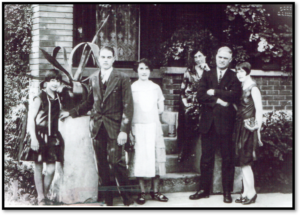
Housekeeper, Dr. George Anderson, Mildred Anderson. family
When my father died more than 30 years ago, Mother made one request of her three children: she did not want to be buried in Indiana; she wanted to go home to Utah. After her death, with the help of our Utah cousins, we buried her in the Anderson family plot in Evergreen Cemetery. Her Jewish name, Hazel Anderson Loewenstein, stands out among the Anglo-Saxon names surrounding her.
This trip is my opportunity to fulfill a Jewish tradition that distance has made difficult. That tradition is to recite Kaddish for deceased parents each year, at the gravesite, which is something Jewish children are often encouraged to do.
Since Mother died, I have managed to do this only a few times. Returning to Springville with three generations of my family feels like bringing two parts of our family’s history together.
Along the way, I hope to introduce my children and grandchildren to the places that shaped my mother’s life and mine.
We will visit the Springville Museum of Art, where a bench honors how my grandfather’s role as mayor helped bring the museum into existence. I want to show my children and grandchildren my grandparents’ home on West Second South, where I spent so many summers, and, if time permits, visit the BYU campus where my parents were married.
According to family lore, theirs was the first—and last—Jewish wedding held in the BYU Faculty Club because the itinerant rabbi insisted on blessing a cup of wine, creating a local scandal.
My mother never lost her love for Utah, often proclaiming, “When I’m in Utah, I’m a Mormon.” This August, her children and grandchildren will gather around her grave to honor that enduring bond. Mother is, indeed, under her beloved mountains, as she wished to be.
Submitted By Miriam Zimmerman