

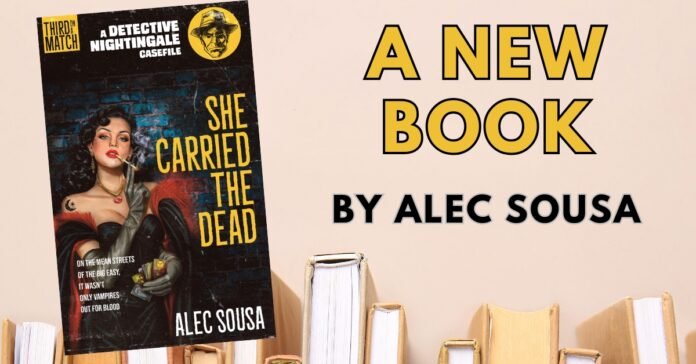
Every so often, a book comes along that feels like it crawled out of a smoky alleyway, dripping with menace and style, clutching a cigarette in one hand and a secret in the other. Alec Sousa’s She Carried the Dead is that book, is a horror noir that sinks its teeth deep into pulp tradition but beats with a very modern, human heart. It’s as much about the monsters that prowl the night as it is about the ones we carry within ourselves.
Set in late 1930s New Orleans, She Carried the Dead follows Detective Nightingale, a weary investigator with a moral compass who’s seen better days. When he’s hired to find a missing girl, the job seems straightforward enough—until it isn’t. The trail winds through the city’s jazz-soaked underbelly, into brothels and barrooms, past fortune tellers and blood-slick back alleys, and straight into the path of something far more sinister than a runaway. By the time the dust settles, Nightingale’s search becomes less about finding someone and more about confronting what’s left of his own soul.
That’s the beauty of Sousa’s writing: It knows exactly what it’s doing. The book leans into its pulp and noir roots with relish—snappy dialogue, cigarette smoke curling through half-lit rooms, a detective who’s seen too much and believes too little. But it never winks at the reader. There’s no ironic distance, no tongue-in-cheek apology for being a genre story. Sousa treats noir and horror like sacred texts, not kitsch relics. He respects the shadows he’s working in.

What elevates She Carried the Dead beyond homage, though, is the depth that runs beneath its bloody surface. This isn’t just a story about vampires and vanished girls—it’s about the cost of survival, the corrosion of doing what has to be done. Nightingale’s world is one where the lines between justice and damnation have long since blurred, and every decision takes a little more out of him. When the supernatural finally crashes into the narrative, it feels less like an intrusion and more like an inevitability. The monsters, after all, have been here all along.
Sousa’s prose walks a fine line between lush and lethal. His sentences carry the rhythm of a trumpet solo—sharp, moody, and a little dangerous. The book’s atmosphere is thick enough to choke on; every page steeped in heat and rot and sorrow. Yet within that decay, there’s beauty. Small, aching moments of grace peek through: a fleeting kindness, a memory that won’t stay buried, a glimpse of what might have been if the world were a gentler place. That push and pull—between brutality and tenderness—is what gives the novel its staying power.
For readers who come for the mystery, the plot delivers all the grit and twists you’d expect from a classic detective yarn. But what lingers isn’t who did what to whom—it’s the emotional wreckage left behind. Nightingale isn’t just a man chasing answers; he’s a man trying to prove that he can still feel something, even as the darkness keeps asking for more of him. By the end, the vampires almost feel secondary to the real horror: what happens when the fight changes you into something unrecognizable.
She Carried the Dead reads like a love letter to the pulp magazines of the 1930s, but written by someone who understands that nostalgia alone isn’t enough. Sousa builds a world that feels lived-in, haunted, and heartbreakingly human. It’s the rare kind of genre novel that can thrill you, unsettle you, and then leave you quietly devastated.
In the end, Sousa seems to suggest that sometimes we need monsters—not to destroy us, but to remind us what’s worth saving. She Carried the Dead is sharp, soulful, and soaked in shadows. If you like your horror with a trench coat and a conscience, this one’s worth following down every darkened street.