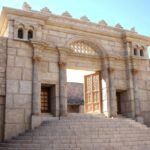


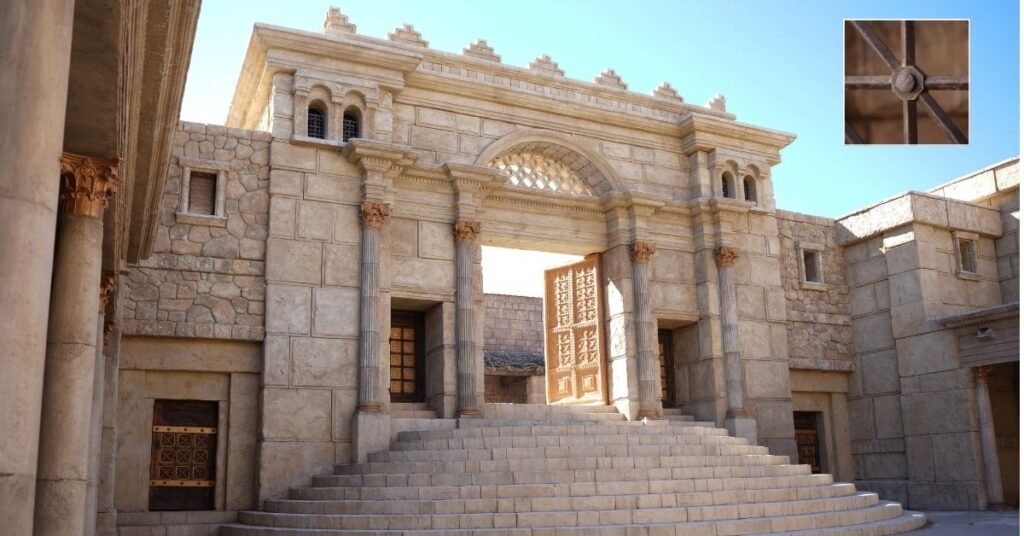
Perhaps the worst kept secret in Utah County is the existence of a film set reproduction of Jerusalem located somewhere south of Utah Lake out in the west desert. With its rolling hills and relatively barren landscape, this setting makes a believable stand-in for the Holy Land — at least when viewed through a camera lens.
The set was designed and built by the Church of Jesus Christ of Latter-day Saints to film key narratives from the Bible and Book of Mormon. It was also generously and famously made available by the church to Dallas Jenkins and his associates for filming “The Chosen.”
This popular Christian series, which still runs on BYU-TV (KBYU), depicts the life and ministry of Jesus Christ and recently finished filming its seventh and final season.
The series is so beloved in Utah County. In fact, when several of its actors were introduced at the Fiesta Days Rodeo in Spanish Fork a few years ago, they received an enthusiastic ovation from the crowd. Even the rough stock bulls and horses milling about beneath the grandstand by the bucking chutes seemed to pause and pay attention.
Although the Jerusalem set is not open to the public, on rare occasions it allows special groups to visit.
Recently, Latter-day Saint film producers David Monsen and John Uibel gave a tour of the area. Those included in the tour were members of the Church of Jesus Christ of Latter-day Saints’ regional communications council, guests from Christian congregations throughout the valley, as well as civic leaders.
Because both Monsen and Uibel were key contributors to the design and construction of the set, the tours were particularly engaging and insightful. As the groups moved through the set, more than one person noted the peaceful atmosphere of the site. Another joked that although he and his wife were booked for a Holy Land tour next spring, they might now consider cancelling it. That’s how detailed and evocative the tour was.
At the beginning of his tour, Uibel told his group that he would be happy to answer any questions anyone might have as the tour went forward because he knew every inch of the set and had watched its construction carefully. As it turned out, he was on even more intimate terms with the set than because he had designed every bit of it on his computer.
He explained that he had spent nine months tucked away in a basement corner, sitting day after day on an uncomfortable folding chair from which, he said, his backside has not yet fully recovered.
God may have designed and created the vast universe that surrounds us, but it was John Uibel who designed and helped supervise the creation of the Jerusalem of Utah County.
The set was built with amazing speed during nine months. Some filming was happening while parts of the set were still being built. All hammers had to stop for silence when the cameras were rolling.
The workers poured the concrete for the streets and started to smooth it as in normal construction practices, but Uibel stopped them, and he and others purposely made the ground rough, wavy, and bumpy to resemble early turn-of-the-millennium streets of Jerusalem.
It was fun to learn about the making of the set, including the walls that look like stone, but that are constructed with Styrofoam and covered with fiberglass. Sawdust was tossed randomly to create a mottled and textured look before painting.
Invited guest Ben Hillyard, mayor of Woodland Hills, said it was fun to “walk around knocking on the walls” because “the huge stone pillars echoed.”
The overwhelming feeling, Hillyard said, was peace.
He said that when he visited Jerusalem with his wife eight years ago, he found Jerusalem to be a bustling, hustling modern town, and not the quiet streets found in the movie set.
It was mentioned during the tour that studios who use the movie set especially enjoy the lack of noise pollution because everything in this rural corner of Utah County is quiet. The silence brings even more peace and reverence to the set.
After visiting the movie set, Hillyard said that he is now ready to go back to Jerusalem and re-see the city with different eyes.
Ellie and Rex Dana, guests from the Orchard Hills Bible Church between Payson and Santaquin, were curious about how the set would not replicate but evoke the feeling of Jerusalem. They said that they were impressed how the set could represent not only Jerusalem, but, by changing the camera angles, the set also represents Capernaum, Nazareth, Bethany, and Bethlehem.
When they went home, they said that they rewatched several seasons of “The Chosen” to see how the sets worked. They said that they noticed that no two doors were alike. “
The architectural style of the doors varied,” they said. “Some had square overhead boards, some were rounded, and some were half round.”
Karen Ellingson, Springville City Council member and communication committee member, said she enjoyed gathering with people from different faiths and backgrounds for this tour.
“It is helpful for someone who is involved in government to have experiences with interfaith and nonprofit groups in a setting where it is quiet and touches on our shared values because we will connect and pull together in time of need,” she said.
Submitted By Delys and Phillip Snyder