
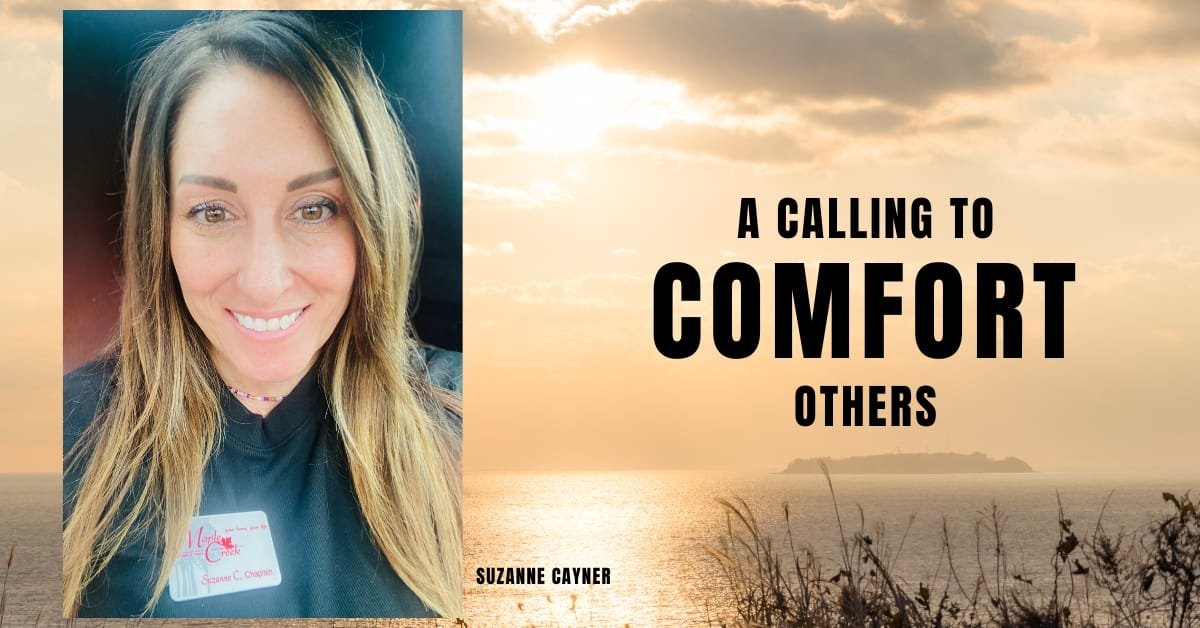
When Suzanne Cayner gets up to go to work as a chaplain at Maple Creek Home and Hospice in Spanish Fork, she thinks back to the little girl who always wanted to help others, and she is proud.
Since Cayner was a little girl, she always wanted to be a helper. She recalled going to school and seeing children who were bullied or not feeling well, and wanting to step in to make it all right.
“Ever since I was a little girl, I’ve always just felt so extremely deeply for other people,” she said. “I always wanted to take care of everybody and make everybody happy. It was a lot for a little girl to have on her shoulders. Whenever I’d see anybody get bullied, I would just go home and it would bug me for days. I couldn’t just let it go; I always felt such a connection to those people, even though they didn’t even know who I was.”

Cayner described struggling with depression as a child and teenager while growing up in what she says was a dysfunctional home.
“My family was pretty dysfunctional,” she said. “I always wanted to fix everything and when I got to my teen years, it really started hitting me that it was just, a lot. I really struggled with who I was and I actually dealt with a lot of suicide ideation when I was in my teens. Back then, you didn’t really get help for that kind of stuff. It wasn’t something you talked about, and so I struggled a lot during that time.”
It was during that time when Cayner said she “turned away from God,” and started to lose her own sense of worth. She struggled through a marriage at a young age, and then as her parents got older, she began to witness some deeper struggles in them.
“I remember my dad getting ready to retire, and wanting to give him a big retirement party because he’d worked at the railroad since he was 18 years old,” she said. “It was a big deal, but instead of him being happy, you could kind of see the depression sinking in a little bit. I think it was hard for him to not be needed and not be known because he was an engineer. He was one of the big guys on the railroad, and so I think it was a lot for him to take.”
Cayner went on to describe the day her dad went missing, after deciding the sadness was more than he could bear.
“Mom had called me that morning,” Cayner recalled. “I had two little kids at the time, and she said, ‘Your dad’s missing, but I don’t know where he is. He didn’t take his phone; all he took was a jacket and his driver’s license — and his gun.’ She knew his gun was missing because she went looking in the safe. So from there, it just doesn’t feel real.”
Cayner described the trauma she and her family experienced when law enforcement was able to locate her dad 25 miles away from his house.
“I don’t know how long he struggled, but because you would never know,” she said. “He was just a big burly man and you would never know if he was really struggling.”
The trauma of losing her dad to suicide in 2012 was only compounded when when her mom was diagnosed with pulmonary fibrosis, a condition that would take her life in 2015. Not long after, she adopted her nephew, whose father (her brother) was struggling with drug addiction.
“I was just really angry, wondering why all these things were happening,” she said. “I remember after my dad passed away, I was in so much pain. I remember going to a suicide support group led by a chaplain named Charn Burton (who Serve Daily reported on in March of 2023). I remember seeing Charn and hearing her story and thinking about how amazing she was. She was so kind and compassionate and she just had this light that followed her wherever she went. I thought, ‘I would love to be somebody like that one of these days.’”
Cayner described grappling with her own insecurities, not knowing if there would be a place for her in chaplaincy. After all, she didn’t follow any particular religion and didn’t even know if she believed in God. Even so, she contacted Burton and began the initial stages of becoming a chaplain. Then tragedy struck again, with her stepson taking his own life.
“I remember it was the week that I was going to finally be a chaplain and I had the news that he had just taken his life,” Cayner said. “It just finally came to a head, and I knew I couldn’t keep living my life like this. I started incorporating more God into my life little by little. I started saying my prayers and felt His presence. It took some time and I finally decided that I was ready to become a chaplain.”
Cayner started chaplain school in 2024, and was able to get a job in January 2025. She said that she feels like it’s right where she needs to be and that she’s “never been happier.”
“I am a chaplain for hospice right now,” she said. “I go around all day and I visit with hospice patients who are in the process of dying or they’re getting ready to die and I just offer them comfort and peace.”
She said that her lack of religious background has helped her to meet people where they are.
“For some, I read scriptures to, and others I read devotions to. We often just sit and talk about whatever, and often don’t even talk about religion or anything like that,” she said. “To me, chaplaincy is a lot of providing comfort, listening and being there for somebody. … If there’s somebody who doesn’t believe in God, I will help them with whatever they possibly do believe. I try to go to different religions and learn about them so I can make them feel the best way possible as they prepare to transition out of this life. It has been so rewarding, and I truly feel like chaplaincy is my calling.
Cayner said that although she has experienced so many hardships in her life, she is grateful for them, because she believes they have prepared to become the person (and chaplain) she is today.
“I think about all the trials and trauma that I’ve been through,” she said. “As hard as that seems —because I had some really bad things happen — I would not be here without all those experiences. So I’m grateful that I’ve had to go through some of those things. When people think life is so hard, there is good to come out of it.”