

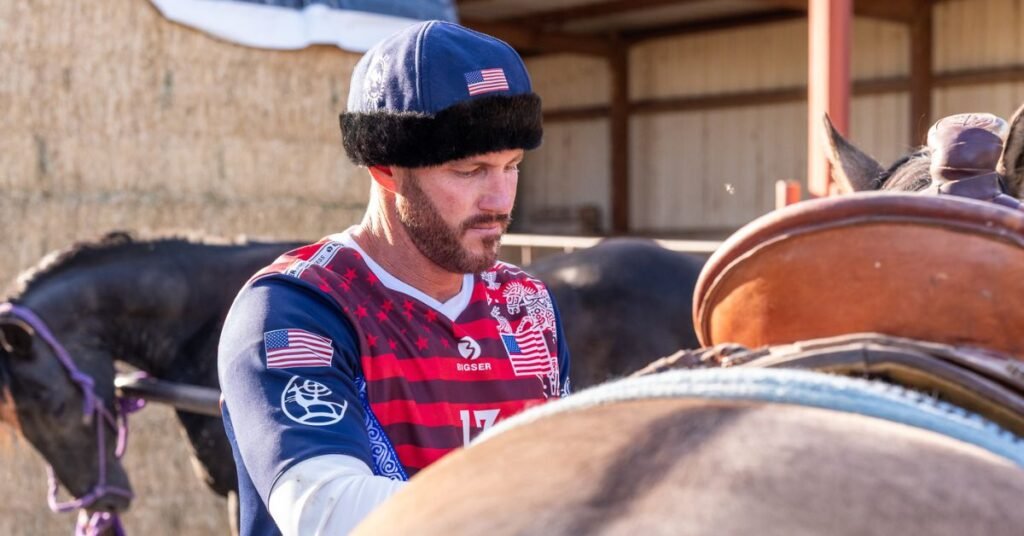
Last month, Genola resident, Brian Ewell, represented Team USA at the World Nomad Games that took place in Kyrgyzstan.
The World Nomad Games is an international sports competition dedicated to ethnic and traditional sports practiced by nomadic cultures. Ewell was one of five men from Utah who represented the United States on the kok-boru team. Kok-boru is the national equestrian sport of Kyrgyzstan.
Kok-boru translates to “gray wolf” and is a tradition that goes back thousands of years. In it, participants pass a goat carcass around while riding horseback, with the goal of trying to score by throwing the goat into the opposing team’s goal.
According to ancestral lore, nomadic herders and warriors returning from long trips would find gray wolves attacking their livestock. The herders would then hunt the predators down on horseback and carry the carcasses back across their saddle. As time went on, this tradition turned into a competitive display of riding skill and strength, and over time, a goat carcass was substituted for the wolf.
Ewell explained that while the sport may seem barbaric, that the players are respectful of the goat, adding that the goat is then eaten so that “nothing is wasted.”
Ewell, 49, has been a horseman and athlete his whole life, but didn’t set out to play kok-boru, let alone be on Team USA. In fact, it wasn’t until recently when he was introduced to the sport.
“I was invited to play by the team captain, Ladd Howell,” he said. “Ladd’s been doing this for a couple of years, and I’ve worked out with Ladd several times. … To play the sport, you have to have a balance of horsemanship, be able to ride a horse well, and have upper and lower body strength. I would compare kok-boru to polo, rugby and football, all kind of in one — on a horse.
“You have to be strong and agile and be able to reach down and grab the goad off the ground,” he added. “Ladd just asked me if I would be interested in being on the team and I thought it would be a great opportunity and a great experience. So, here we are.”
Ewell grew up riding horses and ranching, and as a dad of five children, he’s passed that love on to his kids.
“I’ve always had a passion for horses,” he said. “I remember being a kid and just going off on my own horseback rides for hours at a time. My parents were always wondering where I was and they knew I was probably somewhere up the mountain on a horse. I’ve always loved the ranching lifestyle. I have my own cows and run my own cows. I always just loved that aspect of it. It’s just something I’ve grown up with and something that I love, and something I’ve taught my kids. My kids have done rodeo and they love it. We do it as a family.”
Ewell also has a background in athletics and played football and ran track and cross-country as a collegiate athlete. He said that all of these experiences prepared him to play on the world stage.
“I feel like I’m very athletic,” he said. “I ran for UVU on an athletic scholarship. So, I always just loved fitness. I coach my little boys’ football team now, and that was probably one of the hardest things besides leaving my family for 2 ½ weeks.”
Even with all his equestrian and athletic background, Ewell and his teammates had to go to the World Nomad Games several days early to get some training in and to get used to the horses, which he said were very different from the ones bred for herding cattle.
“These horses are bred to go to war,” he said. “It’s such a surreal feeling when you’re lined up. What you do is you face your opponent right before your match starts. You have your American Flag and you’re facing each other on your horse and they’re playing the music that is hard to describe, but it makes you feel like you’re going into battle.
“It’s intense,” he continued. “Your adrenaline is just rushing nonstop. You’re cheering for your team, but also being ready to go in yourself, making sure your horse is ready to go.”
This year was the sixth World Nomad Games event, and was held Aug. 31 through Sept. 6. The games hosted 106 countries that compete in many events that center around horses. Some events include long-distance horse racing, wrestling on horseback and horseback archery. There is even a game where competitors pick up coins while galloping at full speed.
The United States has had a team participate since the inaugural games and Ewell said that it was an honor to represent Team USA.
“We were fan favorites,” he said. “The fans knew that many of us were brand new to the sport and they loved it and they couldn’t believe how well we played.”
Team USA first faced Kyrgyzstan, then Russia and Uzbekistan — all of which placed in the top four. And while Team USA didn’t win a single match, they had many points scored against teams that have been playing this sport for centuries.
“This is (Kyrgyzstan’s) national sport,” Ewell said. “This is like our basketball. Everyone knows how to play basketball or football and everybody knows how to play kok-boru in these countries.
“We didn’t have that many people from the USA supporting us, but we had so many fans from all over the different countries supporting us and chanting our name, ‘USA, USA.’ We fed off it and it pumped you up and made you proud to be an American.”
Ewell said that he and many of the other players returned home with bumps, bruises and even some gashes, broken ribs and torn muscles. Even so, he said it was an experience he won’t soon forget, and one he hopes he gets to have again.
He also said that win or lose, he hopes he represented his country, culture and beliefs well.
“It was an honor to play their national sport and be there with them,” he said. “We tried to represent our cowboy culture here in the United States, and when I say cowboy culture, it’s like a handshake means something. It’s an honest, good person that is trustworthy and loyal. We also tried to represent our Christian values.
“Most people are Muslim over there, and they’re kind people,” he added. “Everywhere we went, we felt loved. “It was a cool experience.”