
With school in full swing, let’s take a look at how music — in particular, learning music — helps our learning. We often hear about underfunded schools cutting art and music programs in favor of the traditional classes such as math, science, language, history, physical education and sports programs. The question I want to pose is: is this the right thing to do? Many studies say otherwise.
Thankfully, in my observation, our community, and Utah as a whole, understands the importance of music education in our lives. All of the public and private schools I have seen in our community include strong music programs. We have band, orchestra, marching band, various choirs, rock/pop band classes, and music appreciation classes. There are many community choirs and orchestras, stores, private teachers and schools catered toward music. You don’t have to look very far to find a lot of opportunities and resources to be involved in and learn more about music.
With the myriad ways one can embark on a musical journey, it’s exciting to know that not only will many learn an invaluable trade, but will also experience benefits that are more than meet the ears.

In fact, studies involving MRI scans of musicians show that music, especially performing music, activates every area of our brain through engaging the senses.
When a musician performs music, they must learn a new written language called music notation. This language includes a series of symbols written on a music staff that indicates the pitch and length of notes to be played. This builds linguistic skills which in turn, lends itself to learning other languages through symbol and pattern recognition. When this happens, it is engaging the visual senses.
Musicians then need to interpret and translate music notation into the sounds to be heard. In order to do that, they need to recognize different pitches and the distance and relationships between those pitches. This fine tunes the auditory senses to hear relationships and patterns.
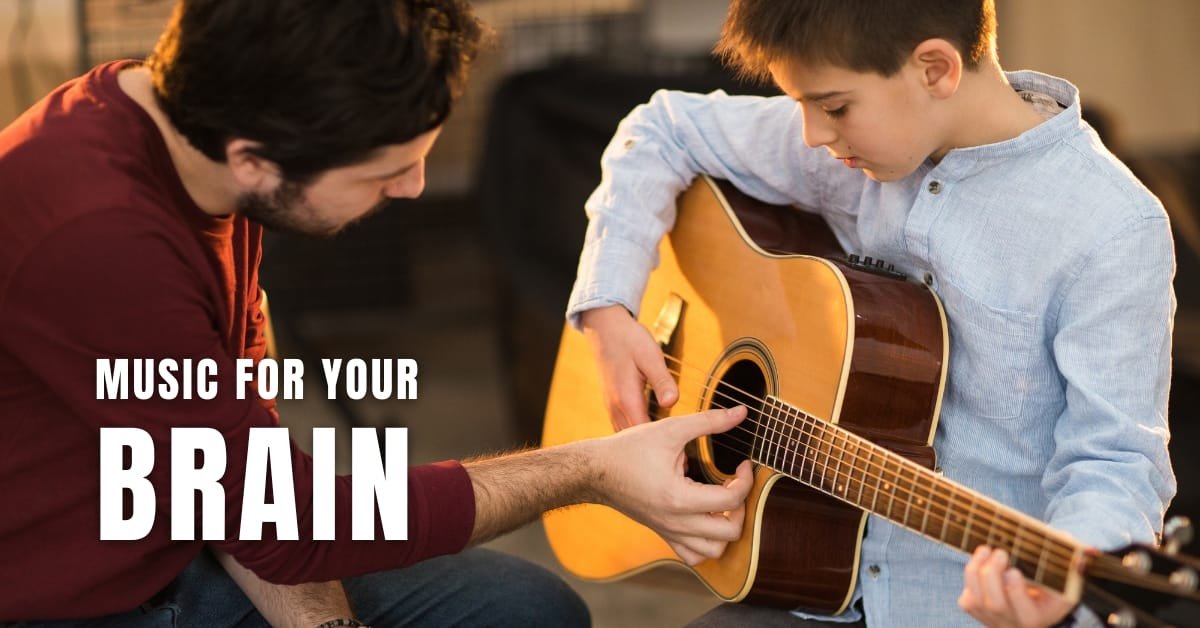
Motor skills also need to be developed in order to create the sounds correctly and at the correct time. This involves training the necessary muscles through repetition of movements and shapes on the instrument they are playing. What this means is that musicians must take their hands, fingers, breath work, and vocal cords to the gym to train them. They are literally taking an inanimate object and making it create music that was written on a piece of paper. That takes some very developed muscle control. This is the physical touch of the music.
Musicians then need to put all of these together and the right time to create and perform music, often with a group of other musicians. This takes teamwork, verbal and nonverbal communication skills, and the fine tuned motor skills to execute. If this involves improvising musicians need to be able to recognize and remember the patterns in the music, look at the options of notes and chords they could play, understand what emotions will be created or portrayed in each option available, and then create something almost instantaneously. These decisions engage the emotional part of music.
How will all of this improve learning in other subjects in our lives? Allow me to break it down for you:
Reading the musical language will make learning other languages easier. Understanding rhythms, dividing notes amongst the beat of the song, hearing the differences in the wave lengths, or pitches, of notes are all math and science at work. Recognizing patterns in the music will help us with pattern recognition in other areas of our life. Making decisions in the moment in relation to the notes and rhythms occurring and creating music based on those decisions will help with decision making and improve our creativity in other areas. Working and communicating with other musicians through the rehearsals and performance will improve our communication and tolerance skills, which will benefit in any other subject or circumstances in our learning and life. Understanding emotions created by the music will help us express emotions and connect with the listeners. That is the essence of art, to have the ability to express, connect, and grow on a cultural, human, and spiritual level with our community.
Whether you are musically gifted or not, or have a big interest in music or not, learning music is a fantastic way to improve your learning abilities, intelligence, and connections in all areas of your life. So go find a music teacher or classes, join a choir or band, go to an open mic night, or any other way to learn music. If it benefits kids learning in school and social skills in the community, it can benefit all of us, no matter how old you are.