
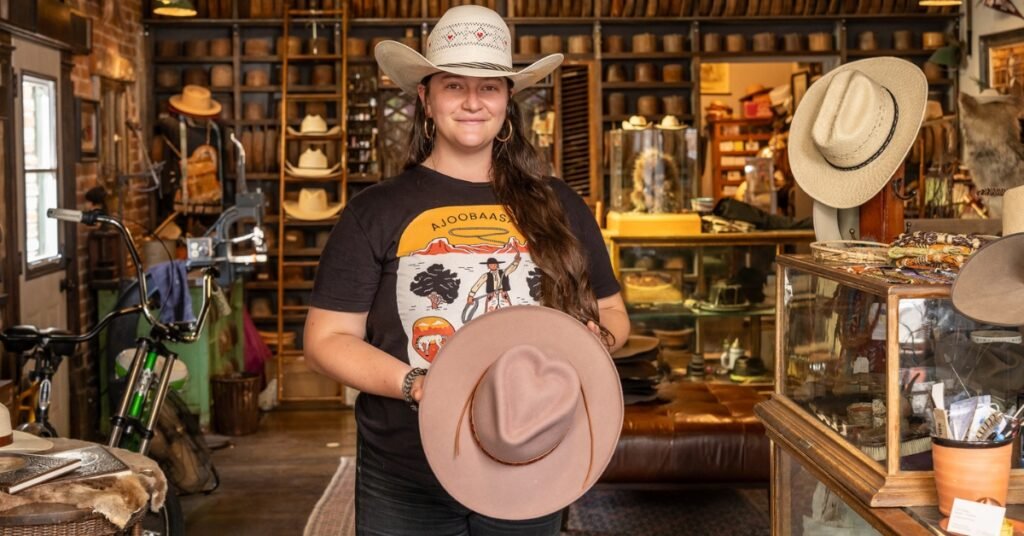
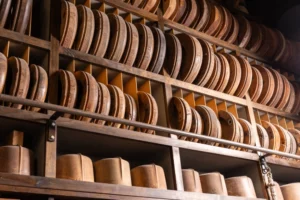
There’s a stillness inside Tatton Baird, surrounded by hats of different styles, different materials, along with the tools used to shape them, shave them, and repair them. The building holds a sense of age, like it’s haunted—in a good way—by the many hands that have worked the same trade. It’s no wonder, really, because the craftspeople at Tatton Baird are the stewards of the original equipment from Utah’s first hat shop, dating back to the 1860s.
“We very much maintain and utilize these pieces in the same way they’ve been used here for generations,” said master hatter Covi King. “If we do our job right, they will persist and last for generations beyond us.
King is one of the co-owners of the Springville hat shop. She had gone to college, earned her degree and landed a job as a political analyst in Phoenix. The problem was, she wasn’t enjoying it.
“I found that I just wasn’t particularly enjoying my work,” she says. “I was looking to do something new.”
Her search for fulfillment led her to Utah and to Tatton Baird. King knew Chandler Scott, the shop’s owner, through Scott’s wife, Anne, whom King had met when she was in college. Having grown up riding horses and wearing hats herself, King was already intrigued by the craft.
When Scott moved his shop from Salt Lake City to Springville and needed employees, King saw her chance. She quit her more conventional job and started showing up at the shop.
“It took me about a month of showing up here regularly —and with annoyance— to Chandler to have him eventually hire me,” King joked.
She began in sales, then entered a formal two-year apprenticeship in hat making. More than a decade later—with a brief departure along the way—King is Scott’s business partner and co-owner of the shop.
Today, the two are carrying on a craft that reaches far into Utah’s past, and that connection between past and present is at the heart of Tatton Baird. They specialize in bespoke hats for men and women, but they also repair and refurbish existing hats. Over the years, Tatton Baird has sold hats in menswear stores from New York and Los Angeles to London and Tokyo, helping the company develop customers across Utah, the country, and internationally.
But making a Tatton Baird hat is decidedly old school. King says the shop models its approach after Victorian-era hat making. Each piece is hand-blocked, hand-finished, pulled, and shaped rather than formed by the pneumatic presses commonly used in mass-produced hat manufacturing often found with other brands.
That approach allows the hat makers to create something specifically for the person who will wear it—and even change it later. A customer might initially order a fedora, for example, then decide a few years later that a pork pie better suits them. Tatton Baird can rework the original hat into something new.
“Your hat can evolve,” King says, but that philosophy lends itself beyond the hat, describing the relationship between craftsman and customer. “We intend to service the hat for the lifetime of the piece.”
For someone unfamiliar with custom hats, walking into a hat shop can feel intimidating. Fedora? Pork pie? Brim size? Color? Then, there’s the question of whether you can actually pull one off without looking like you wandered in from a costume party. According to King, that’s precisely where Tatton Baird’s consultation process comes in.
“It starts with a conversation,” she said. “We have a lot of folks that know they want something, but they don’t know what that is. Part of the consultation process is walking you through a handful of believable options.”
Fittings can happen at the Springville shop or remotely through video calls, email, or even social media. Customers can receive measuring kits, and King and Scott walk them through everything from measurements and colors to proportions and face shape. That means the job sometimes requires skills beyond blocking felt.
“We wear many hats in this business,” King joked. “All bad puns intended.”
Among those hats are consultant, stylist and, occasionally, “professional pep-talker” and confidence giver. Rather than simply asking customers what hat they want, King likes to know what they actually wear. What does their everyday wardrobe look like? Where will they wear the hat? What will make it feel like a natural part of their life?
“How do we fit this into and integrate this piece into what you are already doing and what you’re already wearing?” is a question she said is often asked in her line of work.
That question has helped Tatton Baird develop a broad clientele. Working cowboys still wear hats, of course, as do professional guides, fly fishermen, and hunters. Musicians and actors also make up a significant portion of the shop’s customers, particularly when a distinctive hat becomes part of a public persona. Then there are customers who simply want something beyond a baseball cap.
Tatton Baird tends toward wearable, understated designs—hats meant to live somewhere between a formal suit and a 10-gallon cowboy hat. The goal is to create something distinctive without making the wearer feel as though they are putting on a costume.
For those starting a collection, King said three good hats can go a surprisingly long way. Those hats are a dark hat, a lighter everyday hat, and a straw hat for summer.
Custom straw hats generally range from about $250 to $600, while the felted-fur hats that form the backbone of Tatton Baird’s business typically cost between $700 and $1,300.
King readily acknowledges that a custom hat isn’t for everybody.
“I don’t think everybody needs a $1,000 hat,” she admitted, adding that for those who connect with the craft, the value can go well beyond another piece of clothing.
She explained that some customers sometimes arrive carrying an old Stetson inherited from a grandfather, hoping Tatton Baird can reshape or resize it without losing the history contained within it. Others bring in hats battered by years of actual work. Then, there are new customers commission pieces that, with proper care, may remain with them for decades. That tangible quality is what King was missing during her previous career.
Hat making, she said, is “rich and satisfying work” because it is finite and usually connected to something happy. A customer walks in, King gets to know them, she makes something with her hands, and eventually watches that hat become part of the person’s life.
“You meet the people, you take the order, you build the thing, you deliver it,” King said. “Then you watch the hat and the person age and evolve.”
After more than a decade in the trade, it’s a long way from political analysis. But for King, it’s a perfect fit.
Visit our Website: tattonbaird.com
Call: 801-382-8320