

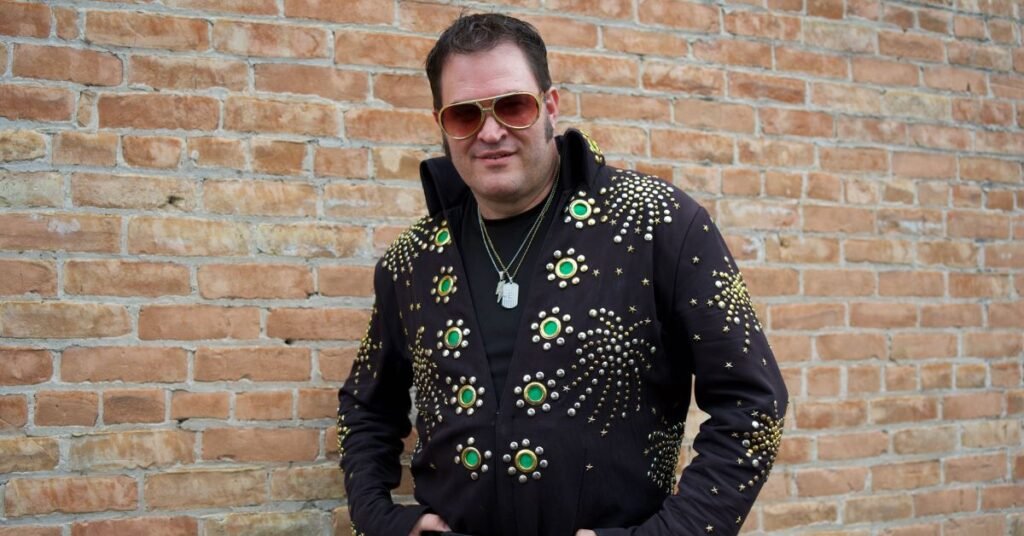
The first time Glen Barker sang Elvis in public, he wasn’t wearing a jumpsuit. There was no stage, no spotlight and certainly no expectation that anyone was about to discover “The King.”
There was just karaoke.
Barker was out with friends when Elvis’ “Can’t Help Falling in Love” came up on the screen. His friends looked around the room and asked the obvious question: Who was going to sing Elvis
“I’ll give it a go,” Barker said.
He had no idea what was about to happen.
When he finished, the room went quiet for about three seconds.
Then came the reaction.
“Holy crap!”
Barker had never taken voice lessons. He didn’t have a formal musical background. But somewhere along the way, he had developed an uncanny ability to imitate singers—and apparently, Elvis was one of them.
After that night, Barker started singing Elvis at karaoke wherever he went. And wherever he went, people told him the same thing: He sounded remarkably like the King.
So Barker decided to see if that unexpected talent could do a little good. He volunteered to perform at an assisted-living center.
“It went really well,” he said. “I was like, holy crap, these guys really loved it.”
What started as an experiment quickly became something much more meaningful. Barker began performing regularly for senior communities, discovering that Elvis’ music could do more than entertain. What he was doing could bring people out of their rooms, get them singing along and, for a little while, give them something to look forward to.
Then COVID put everything on hold.
Barker waited roughly three years before getting another chance to pursue his Elvis act. In late 2024, when his job temporarily ran out of funding, he decided it was finally time to give the idea a real shot.
His wife gave him a goal: Make a certain amount of money by the end of December. Barker started at the beginning of the month. By the end of December, he had performed 25 gigs and surpassed the goal. The next January, he doubled that number.
In 2025, he took on an impressive 230 performances. He estimates he spent 20 to 30 hours a week singing as Elvis, taking gigs wherever he could—including plenty of performances that were free or nearly free.
This year, he entered the Ultimate Elvis Competition in Las Vegas, fulfilling what he describes as something of a bucket-list dream. The competition brought him together with Elvis tribute artists from around the country — many of whom were seasoned performers.
Barker remembers being surprised by how supportive they were. Before he went onstage, he would see the other Elvises gathered together backstage. As he sang, they listened closely.
“They were like, ‘Yeah, he got it. Yeah, he got it,’” Barker recalled.
Even in a competition, there was a sense of camaraderie. Barker left with new friends—and the satisfaction of finally seeing what he could do. But for him, the real reward still comes from the audiences back home.
Barker has performed at senior centers and assisted-living communities throughout Utah, and he has grown attached to the people he meets there. That also means experiencing the difficult side of those visits: returning to a familiar facility and noticing that someone who used to greet him is no longer there.
“I lost a lot of friends along the way as I performed at places,” he said.
Barker is working toward creating a nonprofit that would help bring his performances to facilities that might not otherwise be able to afford an entertainer. His goal is simple: If a community doesn’t have the money to bring Elvis to town, he wants to find a way to come anyway.
“If I had my choice, I would sing all day long every day for the rest of my life for facilities in the state,” he said. “I love it so much, and it’s so much fun, and the residents have a lot of fun.”
And while seniors are at the heart of that mission, Barker doesn’t want to stop there. He also performs at parades, city events, birthday parties, reunions and work gatherings. He even offers an Elvis Christmas set.
Barker learns five to 10 new Elvis songs every month, practicing not only the vocals but also the King’s distinctive movements. Some songs, he said, come easily, while ithers are challenges he has to conquer one at a time.
“Unchained Melody” still intimidates him. “Polk Salad Annie” presents a different challenge: Elvis’ energetic choreography.
He said he’s certain to get there, which speaks to Barker’s philosophy in general.
What began with one karaoke song, has turned into hundreds of performances, a new community of friends, and a mission to use a surprising talent to brighten other people’s lives.