


“If you aren’t doing anything wrong, what are you worried about?”
I hear that question whenever I raise concerns about the new surveillance cameras popping up all over Utah County. My answer is simple: our constitutional rights keep us safe. Free people should not live under constant warrantless surveillance. The real question should be:
“Why should innocent Americans be subjected to surveillance when they haven’t done anything wrong?”
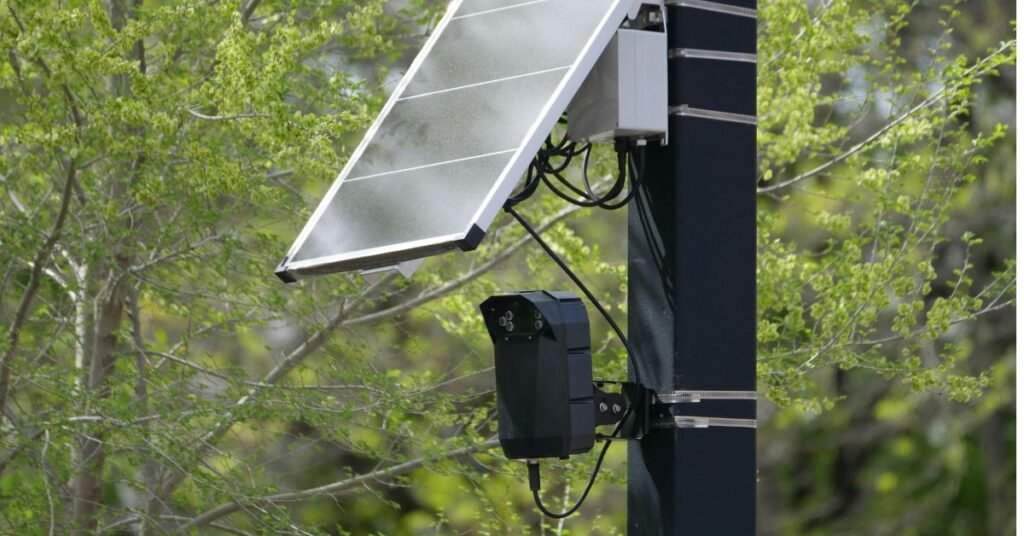
Utah police officers have protected our communities for generations without building a surveillance state. But today, systems operated by companies such as Flock, Palantir, and Axon can collect enormous amounts of information about ordinary people and make it electronically searchable. Flock advertises a nationwide network containing billions of images and videos each month, accessible through powerful artificial intelligence tools.
In my reasoned legal opinion, warrantless mass-surveillance networks of this kind are illegal under existing Utah law.
The Fourth Amendment protects “the right of the people to be secure” against searches. This means that, except under certain recognized exceptions, it is unreasonable for the government to violate your privacy without a warrant. Warrants also limit government to searching the places, people, or things specifically described in them. The principle is as old as the Constitution itself: the government cannot search everyone merely because doing so might someday help solve a crime.
Yet mass surveillance does precisely that. Instead of beginning with a crime and investigating a suspect, these systems collect information about everyone: their vehicles, locations, workplaces, schools, churches, and families, and preserve data for later searches.
Utah Code § 41-6a-2003 establishes a simple rule: except for specifically enumerated exceptions, “a governmental entity may not use an automatic license plate reader system.”
One exception permits ALPR information in an “active criminal investigation,” but that would only apply if an officer had prior documented reasonable suspicion of criminal activity and reason to connect that activity to a particular vehicle, owner, or occupant. Other exceptions allow access to information from a mass-surveillance network, but do not permit Utah agencies to build or contract for the creation of such systems. Utah law even makes knowingly or intentionally using, obtaining, or disclosing captured license-plate data in violation of the Act a class B misdemeanor.
Utah law also prohibits local governments from doing through private surveillance companies what they cannot lawfully do themselves. A “governmental entity” includes a person acting “as an agent of” or “on behalf of” government. Thus, when a private company installs and operates ALPR cameras at a city’s request, with government funding or cooperation, there is a substantial argument that the company is acting on behalf of the government, and the government that approved or paid for the installation of those cameras is liable for those acts. Yet, Axon and Flock publicly advertise capabilities and uses of their systems that go far beyond the criminal limits of Utah law.
Permission to access particular license-plate data for an authorized investigation is not necessarily permission to commission, fund, or operate a continuous surveillance network through a private contractor. Otherwise, government could evade the prohibition on governmental “use” simply by paying a corporation to own the cameras, operate the computers, and store the data.
I fear that is exactly what too many Utah cities and counties are foolishly trying to do. Until this matter is settled in the courts, I expect a flood of litigation and the possibility that police departments, city councils and county commissioners could face jailtime, and millions in losses of our taxpayer dollars.
The Utah Office of Data Privacy’s recent report lends support to my legal argument. In reviewing two law-enforcement ALPR programs, the Office emphasized that § 41-6a-2003 prohibits ALPR use except as authorized by the Act and specifically found no authorization for generalized “electronic surveillance.” The Office recommended that agencies ensure ALPR systems are used only as authorized by Utah law. But how can any Utah agency guarantee compliance throughout a private nationwide network it does not ultimately control?
Utah constitutional precedent should also protect us from these illegal cameras. In State v. DeBooy, the Utah Supreme Court condemned indiscriminate highway searches under both the Fourth Amendment and Article I, Section 14 of the Utah Constitution, saying: “Multi-purpose, general warrant-like intrusions on the privacy of persons using the highways are unacceptable.” State v. DeBooy, 2000 UT 32, ¶ 31. The Court reaffirmed that principle in State v. Abell, 2003 UT 20.
Those cases involved checkpoints rather than cameras, but the constitutional principle should apply with even greater force to an AI-powered electronic dragnet. At least a checkpoint eventually disappears; a networked database never sleeps.
I represent a woman who had one of these cameras installed in front of her home, against her wishes. It watches the place where her children board their school bus and photographs her vehicle whenever she leaves or returns home.
My client has previously been the victim of abuse. She is not worried because she has something to hide. She is worried because information revealing where she lives, when she leaves home, where her children attend school, and all the patterns of her daily life make her less safe.
That danger is not hypothetical. The Institute for Justice has documented more than 100 incidents of Flock ALPR misuse in the past year, including improper searches and wrongful stops. In Georgia, a police chief repeatedly used Flock searches to track his former girlfriend and her teenage daughter. In another disturbing example of automated surveillance technology, Oklahoma resident Kimberlee Williams was incarcerated for six months after faulty facial-recognition software incorrectly identified her as a Maryland bank robber. She had never even been to Maryland.
Critics say license plates are visible on public roads and therefore there is no expectation of privacy, but mere observation is not the same thing as surveillance.
Seeing my car on Main Street is fundamentally different from an interconnected computer system recording everywhere I go and compiling a database capable of reconstructing my movements.
Most Americans would probably object to having drones assigned to fly over their heads every day, recording everything they say and do. So why is it different if instead of a drone, they just put up thousands of cameras and piece together the same data?
The U.S. Supreme Court recently held in Chatrie v. United States that obtaining cellphone location information constituted a Fourth Amendment search. Chatrie did not involve camera networks, but I would argue that camera networks and AI-powered mass-surveillance databases can be significantly more invasive. The underlying principle applies with even greater force: technology should not eliminate our rights merely because individual observations occur in public.
None of this requires distrust of our local police. That is precisely the point. The companies that created these cameras and their artificial intelligence tracking systems are not accountable to our local police and they have built a surveillance system that our own police cannot protect us from, or control. Who exactly is watching us through this system? And what are their motives? We cannot know, because our local law enforcement cannot ultimately control who else uses the network, how the network handles data, or what happens to our information once it leaves their jurisdiction.
These cameras feed privately operated, AI-powered networks that extend far beyond the control of the Utah agencies using them. Once information about Utahns is uploaded into an interconnected private surveillance network, our police, cities, and counties cannot control where it goes. They cannot guarantee who will search it, what other databases it will be combined with, what artificial intelligence will infer from it, or whether it will ever truly be deleted.
Police solved crimes before Flock existed and will continue solving them without illegal mass-surveillance systems. We should not tolerate indiscriminate surveillance merely because some of the information collected might someday prove useful.
Utahns never voted to create searchable records of everyone’s daily movements. We never repealed Article I, Section 14 of the Utah Constitution or the Fourth Amendment.
Our Legislature has restricted governmental ALPR use. Our Supreme Court has declared “general warrant-like intrusions” on Utah highways unacceptable. And federal constitutional law recognizes that aggregated digital location information falls under the Fourth Amendment.
In my reasoned legal opinion: Public-private mass-surveillance partnerships like Flock camera networks, Palantir databases, and Axon systems are probably illegal in Utah and currently exceed the narrow exceptions authorized by law. Government entities participating in unlawful surveillance may also expose themselves to civil and criminal liability, and taxpayers will ultimately bear the cost.
We should demand that our elected officials comply with the law and remove unlawful mass-surveillance devices from our streets, neighborhoods, and schools.
There will always be an argument that surrendering more privacy might make law enforcement more efficient. To paraphrase Benjamin Franklin, I believe that those who exchange their liberty for a little temporary security will end up losing both.
It’s time our local Utah governments started obeying the law.
Submitted by Benjamin Shaffer, Attorney at Law