

More than a decade ago, nearing the tail end of raising seven talented, intelligent, and clever children, I had the audacity to write a parenting advice column. While these same children have grown to be responsible adults — moving out on their own, holding down jobs, marrying and raising children of their own, staying out of jail, building meaningful relationships and leading overall happy, well-adjusted lives — I have since learned how much less I know now than I knew then.
So, this column revisits advice written in the early millennial era, evaluating what is still relevant and applying what I now know.
This comes with a caveat: nobody knows “the best” parenting method in any given situation (except God, but that’s an article for another day.) What I suggest may have worked for me, and, as I said, our kids turned out pretty great so far, but they’re not “finished,” and we’re all just muddling through. Nobody’s perfect. Therefore, neither I nor the paper can accept responsibility for failed attempts in parenting techniques. Because, with children, who knows what they’ll do?

Almost perfect, but not quite: October 29, 2010
My children tell me I am too much of a perfectionist. I worry about the papers left on the floor after the toys are put away, the ammonia still on the counter after the mirrors are cleaned, or whether the monkey sheets actually reach all four corners of the bed. If the main part of the room is mostly clear, does the little stuff really matter? I wonder that myself.
To many grown-ups, a job isn’t “finished” until it’s finished—books back on the shelf, dried cabbage leaves out from under the chair, the carpet vacuumed. Children, on the other hand, don’t see why their play time should be wasted on such small details. They would just as soon leave the marbles buried in the carpet for Mom to step on later. Moms and kids do not see eye-to-eye here. (Maybe because Mom’s eyes are five feet up and children’s eyes are somewhere much lower. No wonder we miss each other’s perspective!)
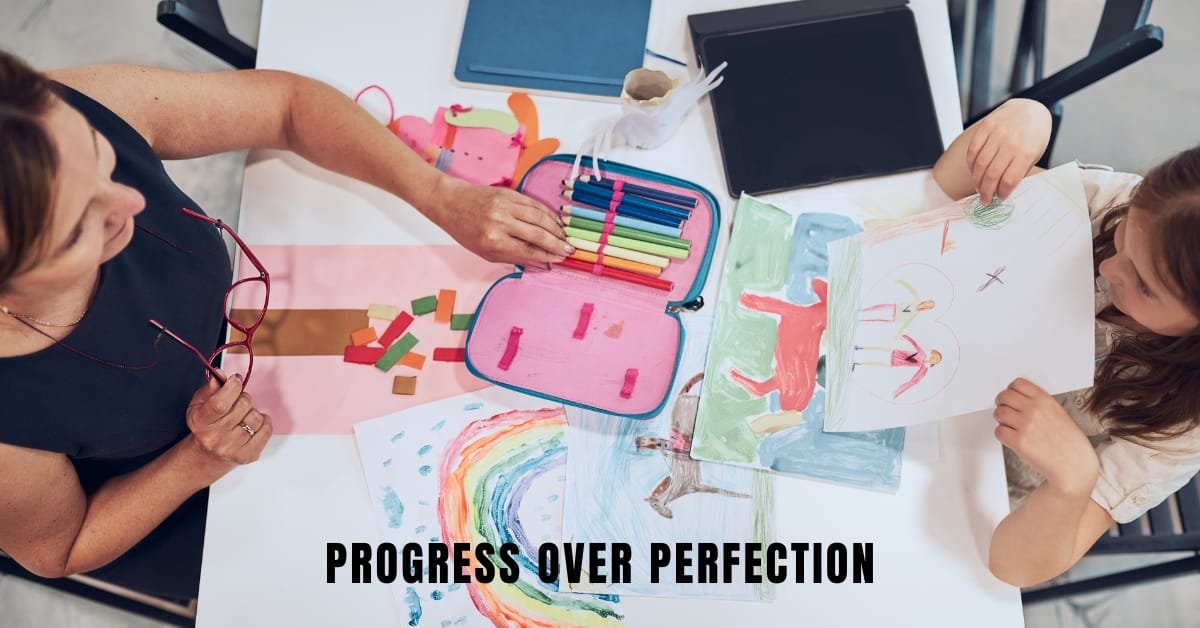
So are the details necessary? I’ve decided they are, but none of us is perfect. People never have time to do everything that needs to be done, and certainly not all the good that could be done. Still, that doesn’t mean we should give up and settle for imperfection. Instead, we keep our eye on the goal of perfection —all the books, toys, papers, and Barbie shoes picked up, the edges vacuumed too. Even if we fall short, the room is still cleaner than before. Next time, we do a little better, and then a little better again. Someday, with practice, we might even get good at it.
If we aim for the stars and fall short, at least we land on the mountain top. But if we aim for the dungheap and succeed—well, that’s not much of a win.
So for our children, we keep expecting the best. We respectfully point out what’s missing, call them back to finish, and praise the progress they’ve made. “That desk looks great! Now let’s see if we can find the floor under all this stuff.” Teach them attention to detail, then step back together and admire the finished job. Help them see how satisfying it is when it’s all done.
In other words: expect perfection, teach details, appreciate progress. Show them how good it feels to work well—and then? Go eat popsicles together.
Dear Younger Self,
One trouble with expecting perfection is that children may get the message that they will never be enough, no matter how hard they try. Gentle parenting says to accept their best efforts, praise them for what they have done and let the rest go.. After all, Church of Jesus Christ of Latter-day Saints church leader Russell M. Nelson assures us that, “The Lord loves effort.”
On the other hand, does the world need adults that never learned how to finish a job properly? Do people receive a sense of satisfaction in a job mostly done?
Perhaps we could tweak the wording a little and say, strive for excellence and then accept a best effort.
A leader of a worldwide young men’s organization put it this way: “God loves us as we are, but He also loves us too much to leave us this way.” (Bradley R. Wilcox)
You could ask your son or daughter what they think this means. You could also teach them that they are capable of much more than they know. Expecting excellence is one way to stretch beyond a “bare minimum” mentality and see how far one can achieve.