

*Editor note: This is part two of an article where author Ariel Higgs talks about her journey getting a service dog for her daughter who suffers from epilepsy. Part 1 is in the July 2025 issue of Serve Daily titled, “Service animals allow individuals with disabilities freedom and independence.”
Deciding on a service animal for someone is not easy. Several factors played a part in my personal decision to pursue that option for my daughter Vivian. The complexity of her health was the biggest factor. The unique combination of her ever-changing seizures and longterm prognosis of her mobility were the biggest factors. I wanted a longterm solution that would also help her be more independent and would grow and adapt with her. I consulted with her medical team and the 4 Paws 4 Ability staff to make sure that a service dog would be a good fit for her medical conditions and made the decision to move forward with getting a service animal.
Though service animals are protected by the Americans with Disabilities Act and considered to be medical devices, they are not covered by any insurance companies. The cost of training and raising a service animal falls to the patient or organization involved with training the dog. The cost of raising and training these elite canines usually ranges between $40,000 to $60,000. With 4 Paws for Ability, I was responsible for $20,000 of those costs through fundraising before I was able to join the list for placement.

I waited for about a year before we were told that Vivian and I would be part of the Pacific Blue class that would meet in June of 2025 to receive our specially trained service dog. Six months before our class started, my daughter was matched with her service dog partner.
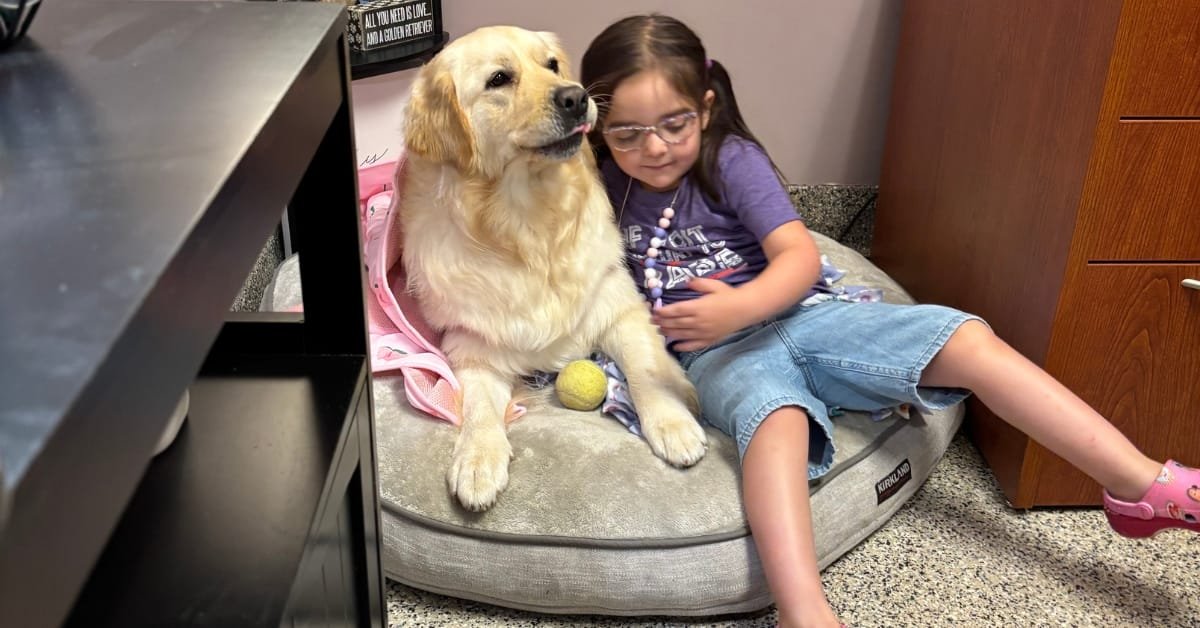
Babe, a golden retriever that had begun her training only days after birth to become a service animal. 4 Paws runs a very tight ship. Puppies are born from hand-selected parents who have all of the best qualities expected of service animals. They are raised by dedicated staff and volunteers who begin their training just a few days after birth exposing them to new sights, sounds and smells.
Volunteers and trainers alike also teach them how to behave in public and cultivate important skills they need for their future jobs. Babe was trained to recognize and alert to seizures, provide deep pressure therapy, stand and brace for mobility assistance, behavior disruption, and push buttons (my personal favorite).
In June of this year, I took Vivian, along with my husband and a close family friend, to Xenia Ohio to pick up Babe from 4 Paws for Ability. We spent two weeks learning everything about what Babe knew and how to handle her. 4 Paws for Ability is the only organization that allows three-person teams, allowing those with more serious disabilities and children to have the benefits of a service animal without being responsible for handling the dog on their own. The training was challenging, but the team at 4 Paws were wonderful, helping us through every challenge and preparing us for continuing progress at home.
Babe has already been a blessing to Vivian. She has pre-alerted to one seizure allowing me to get safeguards in place and contact the doctor. Babe has also greatly increased her confidence when walking, allowing her to go more places and experience more things than ever before. We are so thankful to each member of the community that helped us get here and who have welcomed Babe with open arms. If you’d like to follow Vivian and Babe’s story, feel free to follow me on Facebook or Instagram at Ariel Hanson Higgs or by the tag #babetheservicedog.