


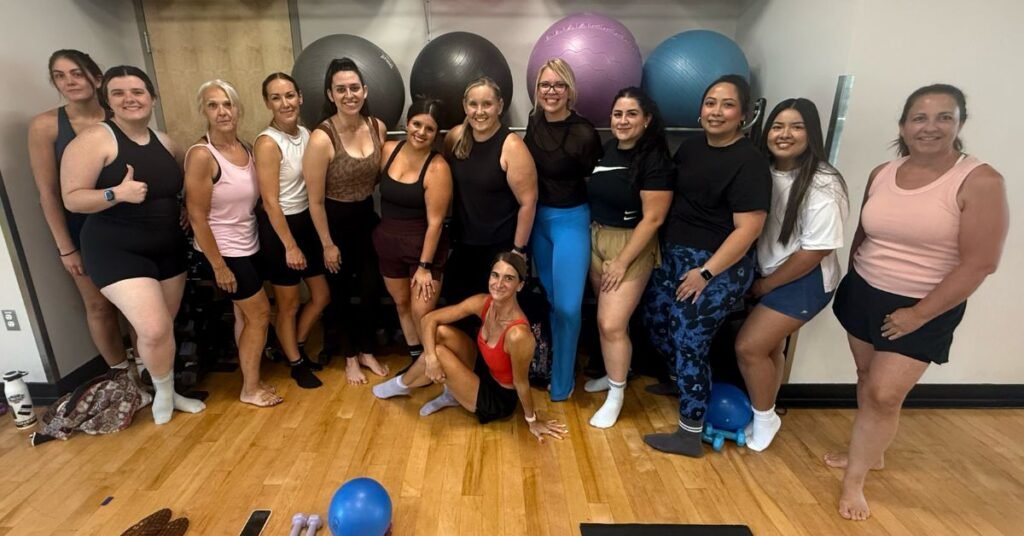
A good workout is more than breaking a sweat. For Lauren Mortensen, it means feeling comfortable enough to be yourself and finding a little more confidence in what your body can do.
For Madsen, it’s also about shaking your hips to the music, laughing with the person next to you, and realizing that exercise can be fun.
All this and more is the spirit behind Mortensen’s Upbeat Pilates class at the Clyde Recreation Center, where traditional Pilates principles meet upbeat music and choreography.
“Upbeat Pilates takes those same general principles that have existed for so long with Pilates, and we just try and make it more fun,” Mortensen said.
The class is a mat-based workout focused on core strength and mobility, but instead of simply moving through exercises with music playing in the background, the entire workout is choreographed song by song. The rhythm gives participants something to move with — and something to look forward to.
Mortensen says music can also make a challenging workout feel a little more manageable. Participants know when they hear a change in the song that a break is coming, giving them the motivation to keep pushing for just a little longer.
“Science shows that your rate of perceived exertion is significantly lower when you’re working out to good music than if there were just beats in the background,” she says. “It makes it feel easier — even if it’s not easier — so you’re able to push yourself more.”
But the real magic of the class, she says, happens when people realize they are capable of more than they thought. In fact, Mortensen admits that Pilates can sometimes feel intimidating, and often carries an unfortunate reputation for being exclusive or even elitist.
She said she loves helping people see that Pilates is not reserved for a certain type of person or body.
“I have people who are Cougarettes or ballet dancers or gymnasts in their 20s and coming to class,” she said. “I have pregnant women. I have 75-year-old women. I have people coming back from surgery. Anyone can come to class, have a great workout, and feel challenged, whether they’re male, female, old, young, injured, active, whatever.”
Due to Pilates being low-impact and highly customizable, Mortensen believes nearly anyone can find a place in the class.
To make sure everyone feels included, Mortensen offers modifications and customizations, sometimes demonstrating two options and sometimes as many as 10. Participants can add weight or instability for an extra challenge or choose movements that provide more stability when they are recovering from an injury or need additional support.
Mortensen’s classes speak for themselves, but her credentials only add to why her classes are so popular and effective. studied exercise science at Brigham Young University and said she has always been interested in fitness and the human body.
Her appreciation for group fitness, however, grew after she became a mother, when she said that finding time to exercise was difficult. Like many new moms, she said that she felt as if she was becoming a new version of herself, and returning to a gym was intimidating.
For her, group fitness solved many of those problems. In it, she found a welcoming space where she could work out, build friendships and feel like herself again. Her newfound community helped her make exercise a consistent part of her life, and it became something her children enjoyed, too.
“It’s been such a vital part of how I find joy, how I find purpose, how I build community, and who I am and what I value with my family,” she said.
Eventually, she discovered the Upbeat formats and loved them enough to become certified to teach them. When her family moved to Wyoming, she was disappointed to leave the classes behind, but with no other options, she started teaching them herself.
She eventually returned to Utah, and she was able to pick it right back up again. What she soo found was that the community that formed around her classes became one of the most rewarding parts of the experience.
Mortensen loves watching participants arrive early and talk or linger after class to continue conversations. Longtime participants welcome newcomers, explaining how the class works and inviting them to stand nearby. In her philosophy, the workout becomes a place where people can feel safe, supported, and connected.
She also hopes that message reaches anyone who has been waiting for the “right” time to start.
“You can come exactly how you are,” she said. “I want you to come as you are, and I will make sure that you are able to do this workout.”