

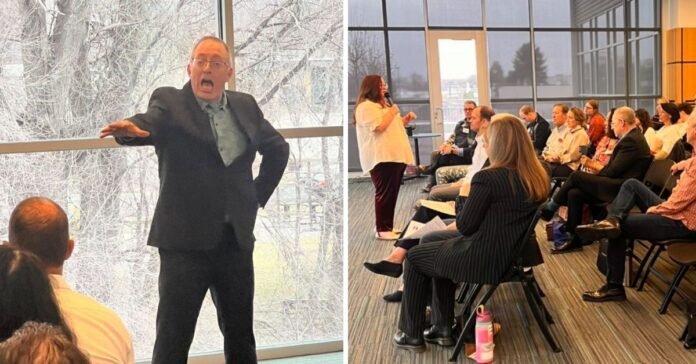
The National Institute of Mental Health and the Gallup News Service often cite public speaking, heights, and spiders as our greatest fears. Those no longer shape my decisions.
Avoiding growth, however, nearly did.
I had plenty of excuses for not going. I prefer keeping my schedule open so I can decide in the moment how to use my time. I didn’t want to be vulnerable in front of others—many of them younger, sharper, and more practiced than I was. And the commitment felt heavy: speeches without notes, memorization, repetition. All things designed to expose weaknesses rather than hide them.

With experience comes a subtle shift. Effort is no longer measured by growth, but by efficiency. We learn how to meet expectations without stretching ourselves. “Good enough” begins to feel responsible—evidence of balance, wisdom, even restraint. But over time, it quietly trades ambition for comfort.
Keeping my schedule open felt like freedom. It allowed me to respond instead of commit, and to stay flexible instead of accountable. What I didn’t want to admit was that flexibility also made it easier to avoid situations where improvement was the explicit goal. Growth rarely fits neatly into open space; it demands intention.
These excuses sounded reasonable, but they felt increasingly hollow. They weren’t protecting my time; they were protecting my comfort.
I adjusted my schedule and committed to attending. Even then, resistance lingered. I woke up that morning thinking I could use more sleep. As it came time to leave, I knew that if I wasn’t on time, I wouldn’t go at all. I almost didn’t go.
The parking lot felt slower than it should have been. By the time I reached the door, I had already found reasons to hesitate—letting others pass, adjusting my pace, buying myself time. Inside, signs pointed clearly where I needed to go.
At the top of the stairs, a table waited with neatly stacked papers and pens. People clustered around it, talking easily. I signed in quickly, keeping the interaction brief, and scanned the room for a seat near the back. I was there to observe, not engage.
Most of the people around me were clearly comfortable—members of the club, animated and at ease. I wasn’t one of them.
As the meeting unfolded, its deliberate structure became clear—each segment placed rather than improvised.
When William Boardman began speaking about Dreaming in 3D, the room settled. He talked about decisions—not as preference, but as commitment. To decide, he said, is to cut off other options. The word itself meant exactly that.
Sitting there, I realized I had already been deciding all morning—cutting off the option to leave, the option to remain unnoticed, the option to stay comfortable.
Later, Michelle McCullough spoke about emotional intelligence and how the inability to manage doubt often derails otherwise capable people. I recognized the pattern immediately. The obstacle wasn’t skill; it was hesitation.
The discomfort I felt wasn’t fear of speaking; it was the realization that growth requires narrowing choices, not keeping them open.
During the Vietnam War, my father received a battlefield commission. Newly appointed as a second lieutenant, he understood that leadership required more than rank—it required the ability to communicate clearly under pressure. He joined a local Toastmasters club not to become confident, but to become effective. As a child, I admired his speaking ability without understanding why.
With age, I’ve come to see that knowledge and experience mean little if they cannot be communicated. What my father learned under pressure, I am learning with time—and time is the one resource that cannot be replenished. Each day, there is less of it than there was yesterday.
The National Institute of Mental Health may be right about what people fear most. But fear changes with age. When we understand that each day isn’t one more day, but one less, we start giving value to what truly matters. For me, that meant choosing growth over comfort—before the choice is no longer mine.