

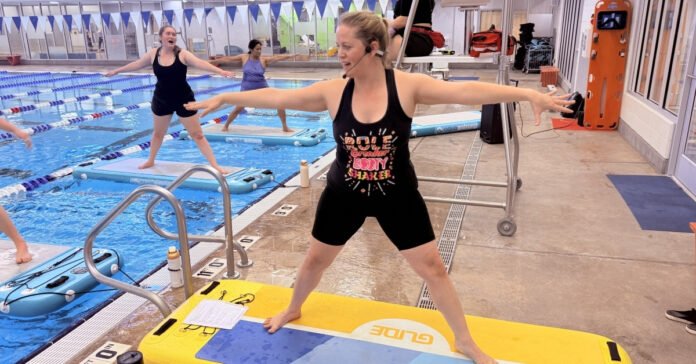
On a Thursday evening at the Clyde Recreation Center in Springville, the pool looks a little different than usual. Instead of lap swimmers slicing through lanes or kids clinging to the edge, a line of floating mats stretches across the water. They’re long, narrow, and just unstable enough to make even confident athletes pause before stepping on.
This is Glide CardioWave—and if instructor Lisa Langton has anything to say about it, that hesitation is part of the magic.
“It’s an exercise class where we have mats floating on the water,” Langton explained. “They’re attached at the long ends, so they’re not totally stable to stand on and you have to hold your balance. It’s a good overall body workout, especially for your balance muscles.”
That instability is what sets Glide CardioWave apart. From the moment participants step onto the floating mat, their bodies kick into high gear, engaging core and balance muscles almost automatically. It’s a full-body workout disguised as something that looks—at least from the deck—like it might be easy.
“It’s very effective very quickly,” Langton said. “I have had people come and after their second or third time, they say, ‘I am noticing a difference in my balance already.’ I had one friend who came and after her third time, she said she was able to stand on one foot and put a sock on her other foot.”
One participant told her that after just three classes, she could stand on one foot and put on a sock without wobbling—something she hadn’t been able to do before. It’s a small, everyday win, but one that highlights what Glide CardioWave does best: translate fitness gains into real life.
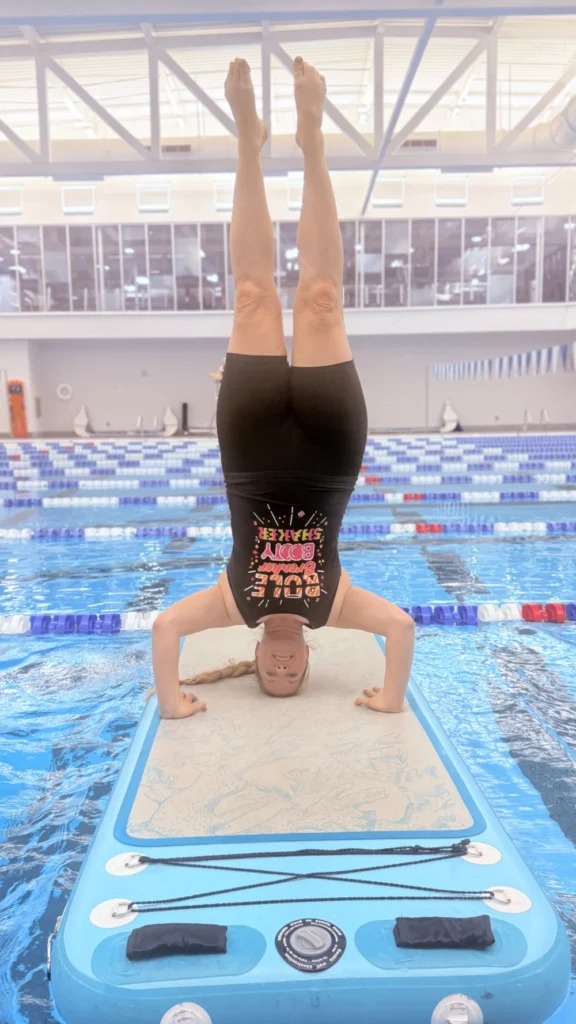
While balance is the headline benefit, it’s far from the only one. The class blends cardio and strength training, with Langton intentionally programming movements that target arms, legs, glutes, back, and core. And because the mat is constantly shifting beneath participants’ feet, the workout never really lets up—even during simpler movements.
“The whole time you’re on the board, even if you’re just standing on the board, you’re having to use muscles just to stand,” she said. “I think that’s probably a good way to put how different it is from any other workout that you would take just in a studio.”
This is also a workout that doesn’t take itself too seriously. Sometimes, people fall in. Langton considers that a feature, not a flaw.
“It’s a different kind of workout,” she says. “Sometimes you end up in the water and that’s just a part of the fun.”
Langton has been teaching fitness classes since 2014 and has been involved in exercise in one form or another for most of her life. What started with workout videos in her basement eventually turned into live classes and, in 2019, certification to teach Glide CardioWave. When the recreation center was looking to add new and unique water-based fitness options, she jumped at the chance.
“I just really love being able to share something that I love,” she says. “Helping them reach their goals and knowing that it is an effective, fun class just makes it even more worthwhile.”
As for who Glide CardioWave is for, Langton resists putting it into a neat box. It’s technically a water class, but participants spend most of the session on the mat rather than submerged. Some people with past injuries do great. Others decide it’s not for them. And that’s okay.
“I have a lot of people who will get on the board and say, ‘Wow, that was actually harder than I thought it was going to be,’” she says. “But I also have had people who said, ‘Wow, I didn’t think that I would be able to do it, and I was able to do it.’”
That sense of surprise—both at the challenge and at one’s own ability—seems to be at the heart of the class. Glide CardioWave asks participants to trust their bodies, embrace a little instability, and maybe even laugh when things get wobbly.
Langton’s advice for anyone on the fence is simple: try it.
“If you want to give it a try and have some fun and see if you’re sore the next day, then you’ll know that it might be for you.”